











.
The first floor of the Gaches Mansion will be covered with Crazy Quilts and Other Embroidered Fancies. The Crazy Quilt fad ran wild from about 1880 through the late 1920′s. The earlier quilts are often made of silk fabrics and are highly embellished with a wide variety of embroidery stitches.
The embroidery may just cover a seam or may be used to fill an area with flowers or names or random designs. Crazy Quilts may have three dimensional elements such as flowers or buttons. Some have painted scenes or inked cartoons or words. A few in our collection even sport a crocheted edging. Later period quilts might be made of cotton, rayon, or wool fabrics. As the Crazy Quilt fad dies, quilts become more structured but still retain some embroidery.
The Museum owns a nice collection of Crazy Quilts that range from the 1880 to the early 1930′s. We will have the highly embellished fancies as well as the more lowly wool and cotton variety on display through March.
.
.
Innovation/ Restoration Quilt Challenge
 At the beginning of this year, a Board Member of the La Conner Quilt & Textile Museum, Joe Pepia, suggested a quilt challenge as a way to raise money for our Capital Campaign project. Once the theme was decided, an invitation was sent to fiber and quilt artists across the United States and Canada.
The challenge was to design a work based on the theme: Innovation/Restoration. The challenge had only a couple of rules: works were to be 24 in. by 36 in. (or smaller) and the pieces were to meet the general criteria for a quilt. However, artists were allowed a rather free interpretation of those rules.
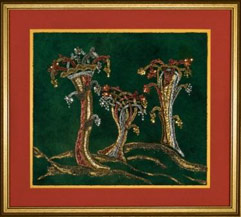
The first entry to come to the Museum was The Restoration of the La Conner Quilt Museum by Thom Atkins, CA (seen at left.) It is an innovative creation using photo transfer, painting, netting, and beading. As you walk through this exhibit, you will see many other techniques used and a wide range of materials. Add the creative talents of the artists and the end result is a collection of one of a kind works of art. The pieces will be on display at the Gaches Mansion through March.
It will be obvious when you view the works that the Innovation part of the challenge was easily met by the artists. The works are currently available for a traveling exhibit. Eventually, they will be auctioned and the proceeds will help defray the cost of the Restoration of the Mansion.
Thank you-to all participating artists! Watch our website for information about the traveling exhibit and the dates for the sale of these fine works of art.
Staircase Exhibit
A second challenge was issued to a local group of quilters to create a small quilt (not to be larger than 144 inches around) using batik fabrics. This group of quilters regularly meets to take classes with Sandy Bonsib and over the years have become friends. They were given two 2 ½” strips of two different batiks and were told to use them in the work. Please don’t get upset if you see that not all of the quilters met that part of the challenge.
These works are also donated to the Museum to help with the Capital Campaign. There are just a few left, stop by soon to see these colorful works of art.